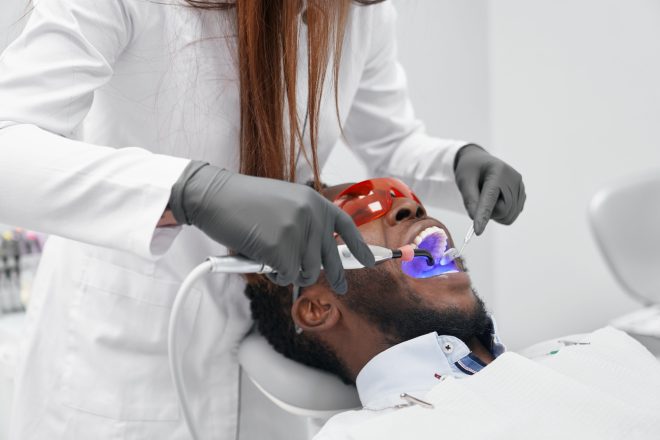
If you have ever heard the words “you have the beginning of a cavity”, you know that sinking feeling. But here’s something many people don’t realize: early tooth decay is not a dead end, it’s a warning light. And in modern dentistry (especially in 2026), we have powerful, simple treatments that can stop decay before it turns into pain, drilling, or major dental work.
As a dentist, I often tell patients this: tooth decay is a process, not an event. It starts quietly, often without pain, as bacteria in the mouth produce acids that slowly weaken the enamel—the hard protective shell of your teeth. If caught early, we can actually reverse or stop that damage.
Let me walk through four of the most common dental treatments that protect your smile and stop early decay in its tracks.
Fluoride Treatments: Strengthening Teeth Like Armor
Imagine your tooth enamel as a shield. Every day, that shield is under attack by acids in food and drinks, as well as by bacteria. Fluoride is like a repair crew that constantly patches weak spots before they become holes.
A fluoride treatment is a simple, painless procedure done right in the dental chair. We apply a concentrated fluoride gel, foam, or varnish directly onto your teeth. This helps rebuild lost minerals in weakened enamel and makes your teeth more resistant to future acid attacks.
In early decay, fluoride can even reverse damage before a cavity fully forms. That means no drilling, no fillings, just healing at a microscopic level.
Think of it like this:
Your teeth are a brick wall. Fluoride doesn’t just clean the wall; it replaces crumbling bricks before the wall collapses.
For children, teens, and adults who are prone to cavities, fluoride is one of the most powerful preventive tools we have.
Dental Sealants: Invisible Shields for Back Teeth
If fluoride strengthens enamel, sealants protect the hardest-to-clean areas of your mouth especially the deep grooves of your molars.
Back teeth are naturally rough and uneven. Food and bacteria love to hide there. Even with good brushing, toothbrush bristles can’t always reach those tiny pits.
A dental sealant is a thin, protective coating painted onto the chewing surfaces of these teeth. It hardens quickly and forms a smooth barrier that blocks bacteria and food from settling in.
It feels like nothing is there, but it works like a raincoat during a storm, quiet, invisible, but incredibly effective.
Sealants are especially helpful for children and teenagers, but many adults benefit too if they are cavity-prone. Once placed, they can last for years with proper care.
Dental Fillings: Stopping Decay Before It Spreads
When early decay has already created a small hole in the tooth, we move to the next level of protection: a dental filling.
A filling is one of the most common dental procedures in the world. The process is straightforward. First, the dentist gently removes the decayed portion of the tooth. Then, we clean the area and fill it with a strong restorative material like composite resin, which blends with your natural tooth color.
Here’s the important part: a filling doesn’t just “patch a hole.” It stops bacteria from spreading deeper into the tooth.
Without treatment, decay can move inward, reaching nerves and causing pain or infection. But with a filling, we seal the tooth and restore its strength.
In simple terms, a filling is like repairing a small crack in a wall before it turns into a collapsing structure.
Modern fillings in 2026 are smoother, stronger, and more natural-looking than ever. Most people forget they even have one.
Professional Dental Cleanings: Resetting the Mouth
Even with perfect brushing at home, plaque still builds up in hard-to-reach places. Over time, that sticky film hardens into tartar, which cannot be removed with a toothbrush alone.
That’s where professional cleaning comes in.
During a dental cleaning, we carefully remove plaque and tartar from the teeth and gumline. This process clears out the bacteria that cause decay and gives your mouth a fresh reset. Regular cleanings are one of the most effective ways to catch early problems before they grow.
Think of it as maintenance for your mouth, like servicing a car before the engine fails.
After cleaning, teeth feel smoother, brighter, and healthier. But more importantly, the risk of cavities drops significantly because we remove the hidden fuel that decay feeds on.
Why Early Treatment Matters So Much
Here’s something I always want patients to understand: tooth decay doesn’t heal on its own once it becomes a cavity.
But before it becomes a cavity, it can be stopped or even reversed.
That’s why these four treatments are so powerful:
- Fluoride rebuilds weak enamel
- Sealants block bacteria from entering grooves
- Fillings stop existing decay from spreading
- Cleanings remove the buildup that causes decay in the first place
Each one works at a different stage, but together they create a full defense system for your teeth.
A Real-Life Picture of How It Works
Let’s say a teenager starts developing early decay on a molar. They don’t feel pain yet.
At a routine checkup, the dentist spots it early:
- A fluoride treatment strengthens the weakened enamel
- A sealant is placed to protect the chewing surface
- Regular cleanings remove buildup around the tooth
In some cases, if a tiny cavity has already formed, a small filling may be done instead.
Because it was caught early, the tooth is saved with minimal treatment—and no major dental work is needed later.
That is the power of prevention.
What You Can Do at Home (This Still Matters Most)
Even the best dental treatments can’t replace daily care. In fact, what you do at home determines most of your oral health outcomes.
As a dentist, I always emphasize:
- Brush twice daily with fluoride toothpaste
- Floss at least once a day
- Reduce frequent sugary snacks
- Drink plenty of water
- Visit your dentist regularly
These habits reduce the bacteria and acid that cause decay in the first place.
Final Thoughts: Protecting Smiles Before They Break
Tooth decay may be common, but it is also highly preventable. The real secret isn’t waiting until something hurts it’s catching problems early and acting quickly.
Fluoride, sealants, fillings, and cleanings are not just treatments. They are layers of protection, each one working quietly to defend your smile from damage you may never even see.
If there is one message to take away, it is this:
The earlier we act, the simpler the solution and the stronger your smile stays for life.
Your teeth are designed to last a lifetime. With the right care and timely treatment, they absolutely can.
NEXT POST: How to Handle a Chipped Tooth in Children: Step-by-Step Guide